
Here is something we did not expect to say this summer: Fire danger is low in Summit County with no fire restrictions for Memorial Day weekend. Campfires are allowed at campgrounds and into the neighboring forests.
But why?
“What we’re doing is really trying to mitigate risk for the community but also recognize that people’s ability to recreate and to have that campfire is important,” county commissioner Tamara Pogue tells Krystal 93.
Pogue and the county board vote weekly to adopt fire bans, but their vote is just one piece of a complicated puzzle.
“We do want folks to believe what we believe,” Pogue continues. “When you are making data-driven decisions, and you’re basing policy on science, it’s easier for folks to getbehind supporting (you decision) and ultimately to comply.”
Fire ban ‘Big 3’
Back in March, Summit County convened more than a dozen local and regional fire experts to preview the summer fire season. We were in the thick of a record-breaking heat streak and counties across the state were doing the same thing. Fire bans, they said at the time, will be strict and widespread. The state’s 2026 wildfire outlook compares drought conditions to the worst in state history, including the historic fire seasons of 2012, 2018 and 2020, when six of the ten largest fires in state history scorched nearly 800,000 acres combined.
Experts spent more than 30 minutes demystifying the science of a fire ban, condensed into what we will call the “Big 3”:
- Data
- Location
- Human factors
The fire ban formula begins with data, including one you might have heard of, “energy release component,” or ERC.
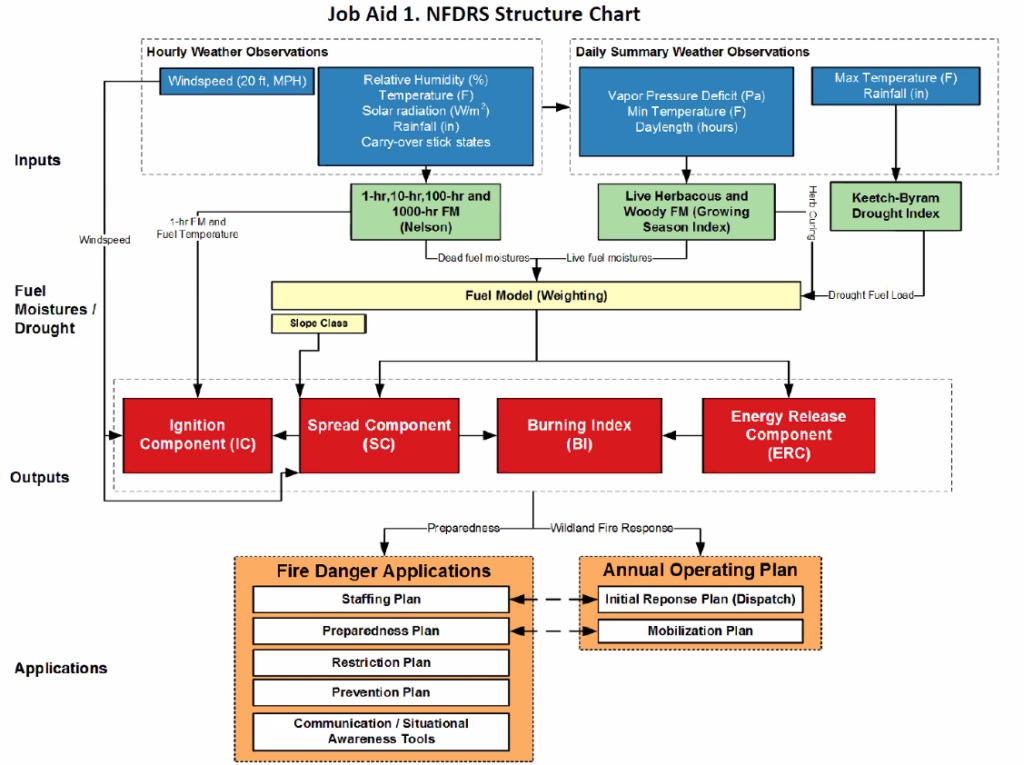
As explained by Dusty Calfee, a U.S. Forest Service engine captain, ERC is, “how volatile we think the fuels are going to be.” The wetter the woods, the safer the forest. When the forest dries out, like it did as early as March this year, it is more prone to fast-moving fire.
Calfee and his peers combine the ERC with other observations, like, “what are we actually experiencing on the ground, or the number of fire starts, how aggressive are those fires moving (and) how challenging are they to control?” These observations are translated into data that informs the fire ban equation.
Then, the experts consider where a fire might start in the forest. This is where the formula gets a little more nuanced because firefighters are dealing with imaginary lines.
“The jurisdiction for who owns that fire is based on the origin of that fire,” Calfee explained. “If that fire starts on private land, it is essentially the fire protections district’s (and) the sheriff’s ownership, until it were to encroach upon a federally managed land like Forest Service or BLM.”
Commissioner Pogue reminds us that fire doesn’t care about these property lines. That is why Summit works closely with the Forest Service and other neighboring counties. Summit Sheriff Jaime FitzSimons says he and federal partners collaborate on every fire, no matter how small.
Finally, experts consider the people in the forest. This is the most abstract, and the most volatile, factor in the equation.
“You’re generally going to have a baseline of risk that is unavoidable,” Calfee said about the human factor.
Continued his partner, then-acting district ranger Sam Massman, “the human component is absolutely critical.” He gave the example of July Fourth, when Summit’s population can double and even triple. Many of those visitors are camping and might not realize our forests are historically dry.
Sheriff Fitzsimons compiles this data weekly and brings it to county commissioners. On Tuesday they reviewed the latest and agreed – campfires are safe for now.
Fire and snow
Fire danger, in many ways, is like avalanche danger. The experts are looking at a ton of data, including what they see with their own eyes, to strike a balance between education and safety.
This explains why you might have a fire ban on a busy holiday weekend, even if there is rain in the forecast. Or, like this year, why there is no local fire ban despite fears of a historic fire season.
As commissioner Pogue tells us, “We believe that it’s better not to go in and out (of a ban), and that once you go in, you’re likely going to stay in for a while.”