
After more than a decade of deals, and multiple battles in water court, a reservoir on Hoosier Pass is ready to grow.
Colorado Springs Utility, the owner of Montgomery Reservoir in Park County, is applying for permits to upgrade the reservoir. This would more than double the reservoir’s capacity by 2032, and supply about one-third of what the growing city needs over the next 50 years.
At tonight’s Breckenridge town council meeting, engineers with Colorado Springs Utility, CSU, explain why upgrading Montgomery Reservoir is vital for the “resiliency, redundancy and efficiency of this collection system,” which sends water to a city of nearly a half-million people almost 100 miles away.
Permits are reviewed and approved over the next two years. Work begins as soon as 2029.
Bigger city, bigger thirst
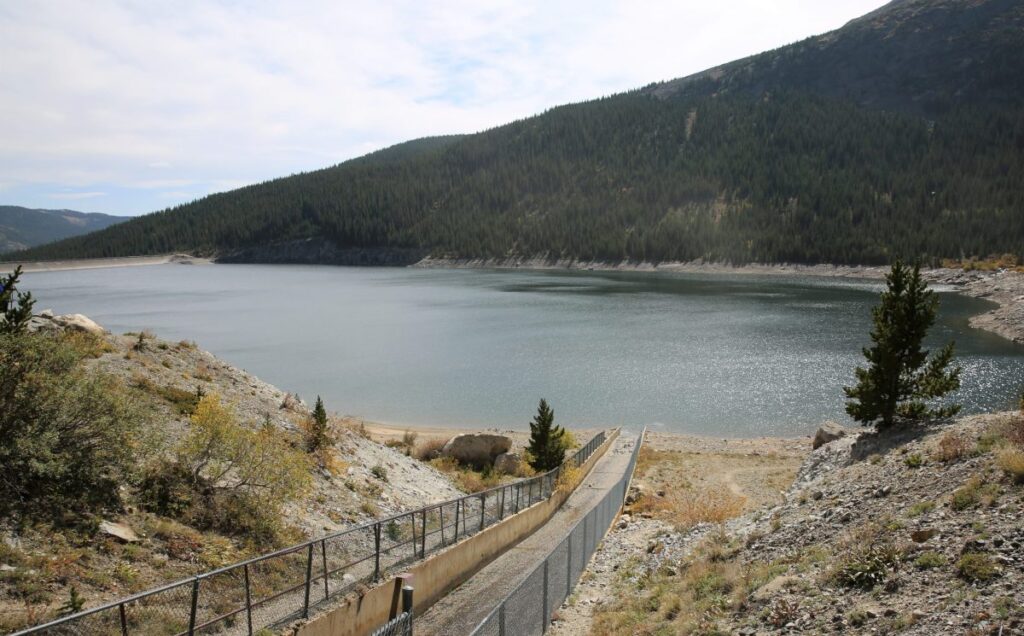
Montgomery Reservoir sits at 10,873 feet at the headwaters of the Middle Fork South Platte River, on the Summit-Park County line, where it collects Continental Divide snowmelt from the peaks above Alma and Fairplay. It also pulls water from as far as the Upper Blue River Basin through a diversion pipe over Hoosier Pass.
The expansion project is called the Continental-Hoosier System Project, and CSU engineers claim it is long overdue. Montgomery Reservoir started filling in the late ‘50s, when Colorado Springs was about one-seventh the size it is today.
“Our 50-year planning forecast expects us to need up to 25,000 acre-feet of additional water supplies to meet demand in the future,” the project website reads. It goes on to say this expansion “allows us to store more water during years of increased runoff,” acting like an investment account in big snow years and a savings account in low snow years.
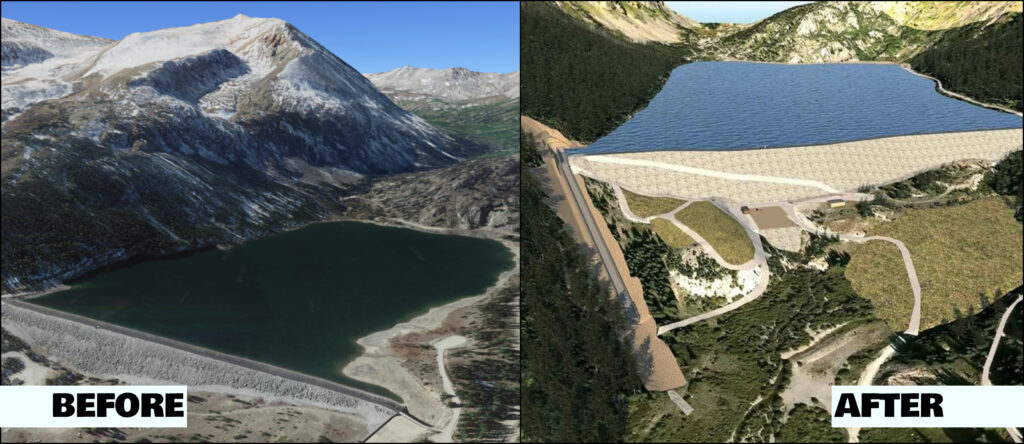
If the expansion is approved, capacity at the reservoir grows by 8,100 acre-feet, from 5,699 acre-feet to about 13,799 acre-feet. That would make it 17 times larger than Goose Pasture Tarn in Blue River. One acre-foot of water covers a football field at one foot deep.
An expansion would put even more pressure on the small creeks that flow into the Blue River, which fills Goose Pasture and waters the town of Breck. Breckenridge Ski Resort has a stake in this project, along with conservation advocates at Blue River Watershed Group and Trout Unlimited.
Water compromise
Since 2015 CSU has fought to make this upgrade happen, giving up water rights it barely used and dams it never built to win support from mountain towns.
In 2024, Aspen Journalism reported the utility forfeited water rights granted in the 1950s for two unbuilt reservoirs at Spruce Lake, south of Breck, and Mayflower Gulch, between Copper Mountain and Climax Mine. In return, the Montgomery expansion would continue unopposed by local stakeholders, including the town of Breck, Summit County and Colorado River District.
For Colorado Springs, the expansion brings water to a thirsty city. For Summit and Park, it means no new dams on two high-alpine lakes, and a little more shoreline for anglers.
“(It) minimizes environmental impacts through redevelopment of an existing reservoir that will continue to provide recreational opportunities for the area after construction is completed,” the project website reads.
Draining the Divide
Like many mountain reservoirs in Colorado, Montgomery is suffering this summer. The Middle Fork of the South Platte today is trickling at one-fifth of its usual flow. Breck officials will learn tonight if ongoing drought could affect this expansion.
Montgomery Reservoir was the first High Country reservoir sending water to Colorado Springs. Today about 75% of the city’s water comes from snowmelt in the South Platte, Arkansas and Colorado river basins, pulled from as far as Twin Lakes near Leadville and Homestake Reservoir in Eagle County.
Plans to upgrade the Homestake system are floundering. A second reservoir there, between 6,850 and 20,000 acre-feet, would send water to Colorado Springs and the city of Aurora, but conservationists say it would flood an already delicate ecosystem. It sits on the edge of a wilderness area that is protected from chainsaws, Jeeps and even bicycles.
Preview image via Park County.